
Social media addiction is the public health emergency being ignored by our Government
The business models of social media are like handing out free cocaine with advertising on it.
Today I woke up to another article about a teenager who killed herself after viewing content on social media. Mia Janin is the third pupil from her school to kill herself since 2017, and it’s taken over a year for her phone to be unlocked by police.
Since Instagram was bought by Facebook in 2012 for $1 billion, the suicide rate for females aged between 10-24 has increased by 94%.
So why:
is the Department for Health & Social Care not involved in the Online Safety Bill?
has there been zero digital media literacy for the public, despite the Government publishing a strategy last year?
does the Online Safety Bill include nothing about the addictive features of social media, or obligations on tech giants to create processes for grieving families to access data?
We’re the frogs slowly being boiled alive, too distracted by numbing ourselves on social media to bother jumping out the pan. Social media free to use, but companies are making more than entire countries because our attention is the product.
Just like capitalism, if we felt happy within ourselves, we wouldn’t necessarily try to improve ourselves. Social media works by exploiting our insecurities, and offering us the solution to fix it, just like CocaCola offering us Diet Coke.
The ‘legal but harmful’ content children are exposed to online existed before social media. What’s different is how carefully crafted algorithms tailored to their unique insecurities infect their brains, splintering their identities between the real and virtual world.
The only companies that refer to their customers as ‘users’ are the illegal drug trade and internet technology. Their income comes from advertising, meaning we need to keep using.
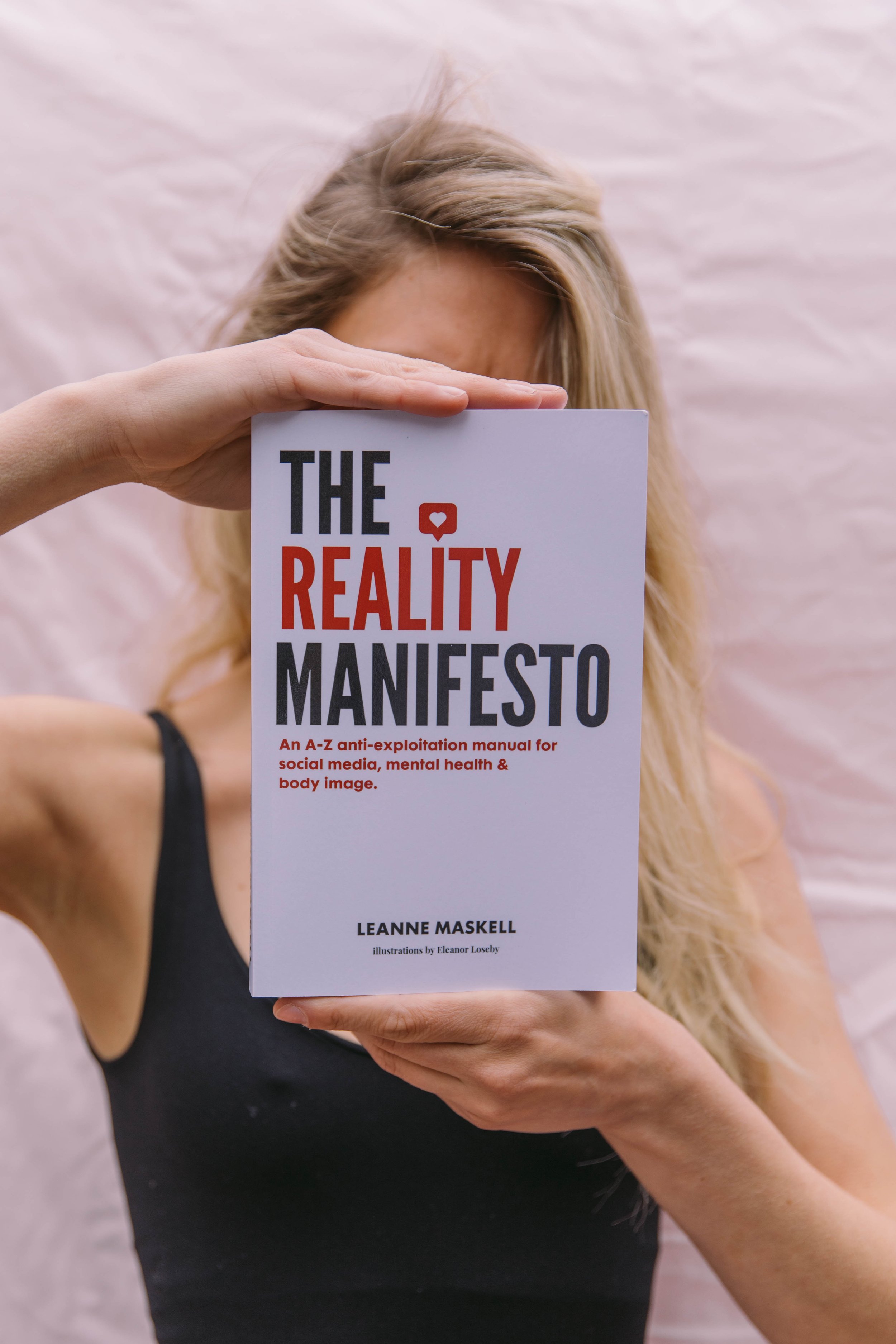
I wrote the Reality Manifesto to try and help, but it shouldn’t be down to me: it should be the Government educating and supporting the public on the dangers of social media, whilst properly regulating it.
The Reality Manifesto was inspired by the child who had her childhood stolen by being treated like a product, including by herself. The girl who lost connection with her body because she started using it as a tool to survive. She believed her worth could be measured and controlled by numbers, growing up trying to achieve the filtered version of herself that was constantly drummed in as being ‘better’ than who she was in reality.
The girl grew into an adolescent who didn’t know how to live a life that wasn’t based on social media. She very nearly died as a result, but survived to tell this story. She grew into a woman who understood that the things that happened to her were not her fault: they were a product of her environment.
That girl is me. I wrote this book because I see the same experiences I had imposed on entire generations of young people, along with impossible standards that simply don’t exist. Many are not as fortunate as I was to have survived. Molly Russell took her own life age 14 after looking at self-harm posts on Instagram, and Frankie Thomas took her own life age 15 after looking at suicide methods online at school.
This book is for every single person that resonates with this. It’s a beacon of hope, calling for change, and a reminder that it’s not your fault.
- Acknowledgements: the Reality Manifesto
The Reality Manifesto: An A-Z anti-exploitation manual for social media, mental health & body image: