
Social media addiction is the public health emergency being ignored by our Government
The business models of social media are like handing out free cocaine with advertising on it.
Today I woke up to another article about a teenager who killed herself after viewing content on social media. Mia Janin is the third pupil from her school to kill herself since 2017, and it’s taken over a year for her phone to be unlocked by police.
Since Instagram was bought by Facebook in 2012 for $1 billion, the suicide rate for females aged between 10-24 has increased by 94%.
So why:
is the Department for Health & Social Care not involved in the Online Safety Bill?
has there been zero digital media literacy for the public, despite the Government publishing a strategy last year?
does the Online Safety Bill include nothing about the addictive features of social media, or obligations on tech giants to create processes for grieving families to access data?
We’re the frogs slowly being boiled alive, too distracted by numbing ourselves on social media to bother jumping out the pan. Social media free to use, but companies are making more than entire countries because our attention is the product.
Just like capitalism, if we felt happy within ourselves, we wouldn’t necessarily try to improve ourselves. Social media works by exploiting our insecurities, and offering us the solution to fix it, just like CocaCola offering us Diet Coke.
The ‘legal but harmful’ content children are exposed to online existed before social media. What’s different is how carefully crafted algorithms tailored to their unique insecurities infect their brains, splintering their identities between the real and virtual world.
The only companies that refer to their customers as ‘users’ are the illegal drug trade and internet technology. Their income comes from advertising, meaning we need to keep using.
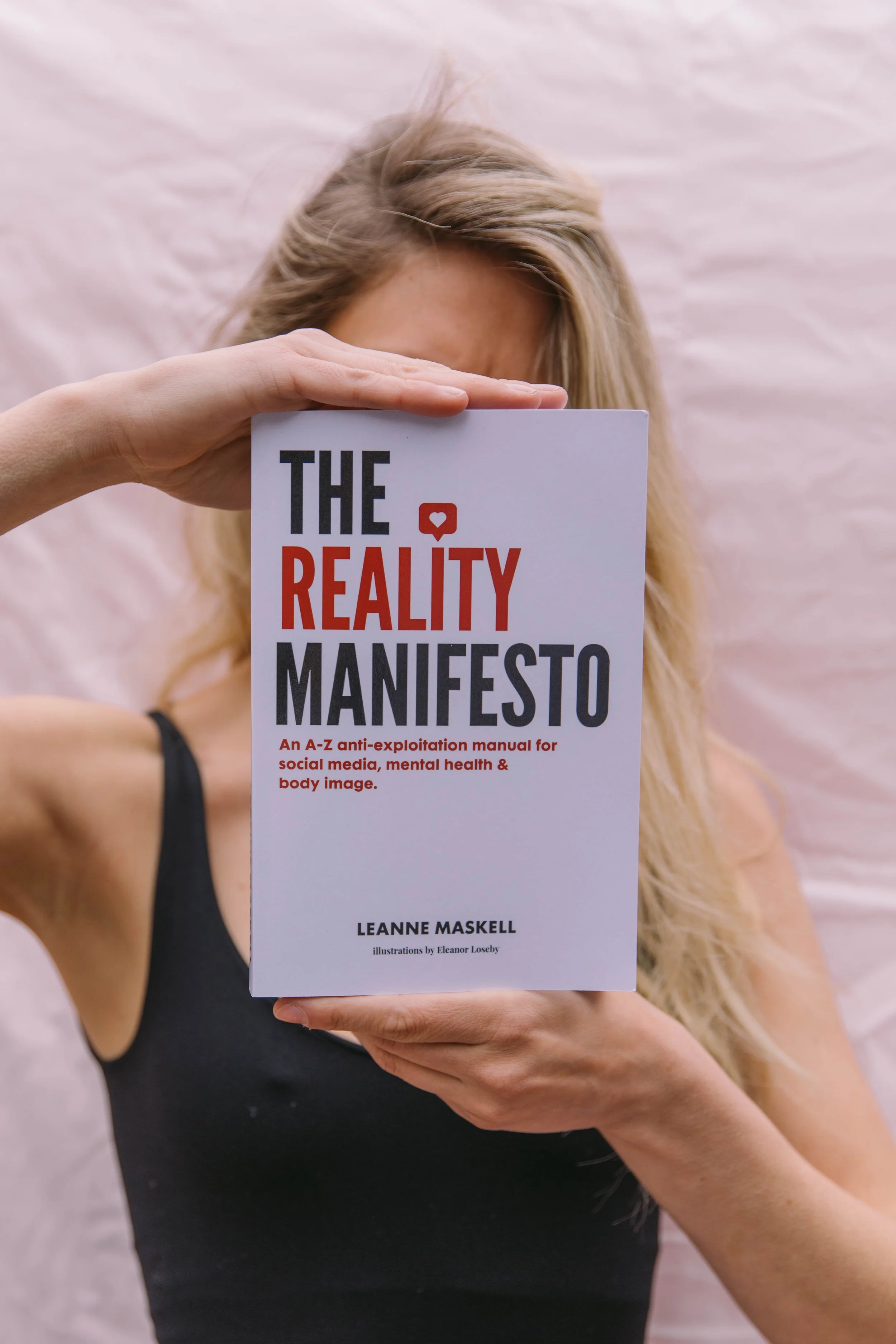
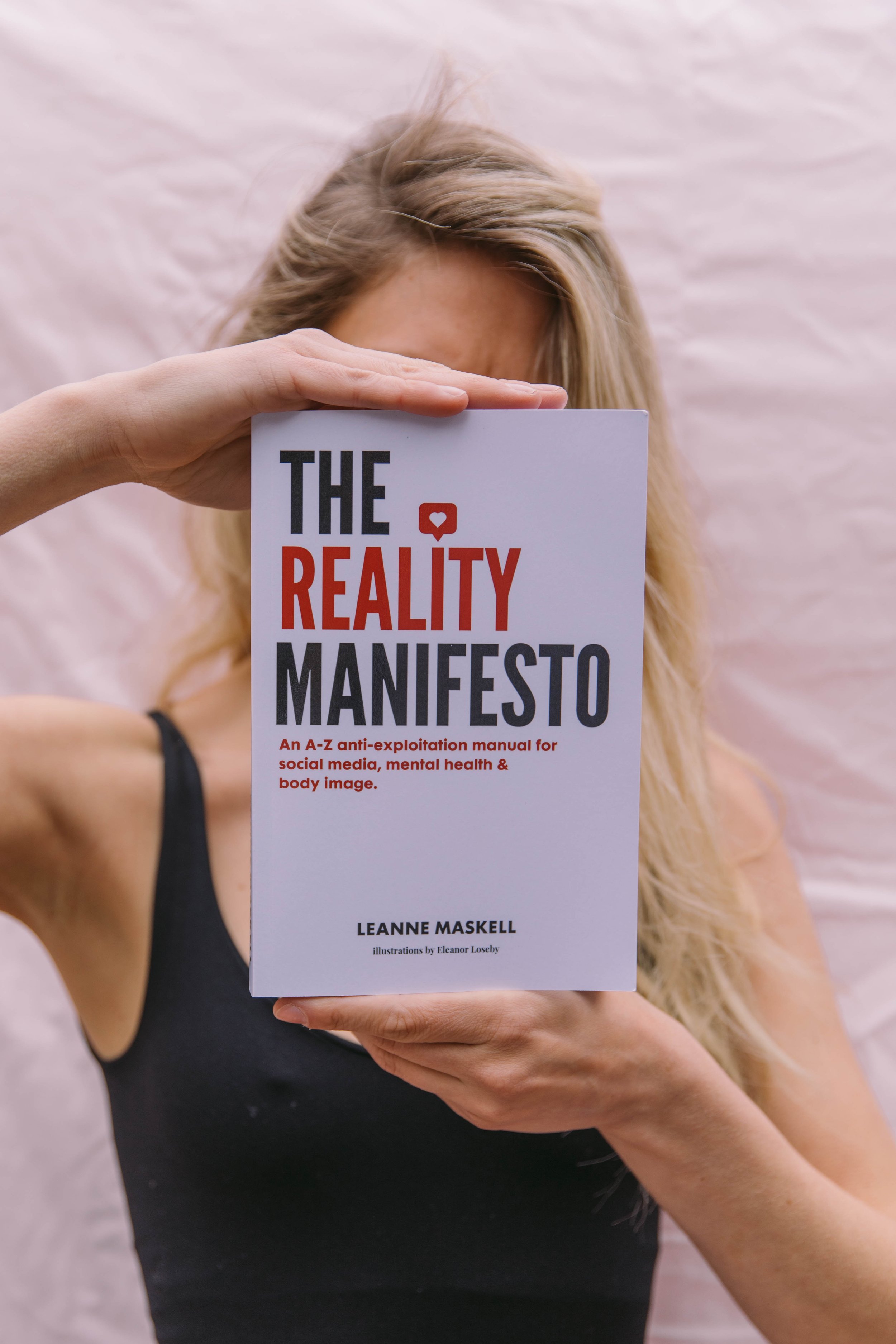
I wrote the Reality Manifesto to try and help, but it shouldn’t be down to me: it should be the Government educating and supporting the public on the dangers of social media, whilst properly regulating it.
The Reality Manifesto was inspired by the child who had her childhood stolen by being treated like a product, including by herself. The girl who lost connection with her body because she started using it as a tool to survive. She believed her worth could be measured and controlled by numbers, growing up trying to achieve the filtered version of herself that was constantly drummed in as being ‘better’ than who she was in reality.
The girl grew into an adolescent who didn’t know how to live a life that wasn’t based on social media. She very nearly died as a result, but survived to tell this story. She grew into a woman who understood that the things that happened to her were not her fault: they were a product of her environment.
That girl is me. I wrote this book because I see the same experiences I had imposed on entire generations of young people, along with impossible standards that simply don’t exist. Many are not as fortunate as I was to have survived. Molly Russell took her own life age 14 after looking at self-harm posts on Instagram, and Frankie Thomas took her own life age 15 after looking at suicide methods online at school.
This book is for every single person that resonates with this. It’s a beacon of hope, calling for change, and a reminder that it’s not your fault.
- Acknowledgements: the Reality Manifesto
The Reality Manifesto: An A-Z anti-exploitation manual for social media, mental health & body image:

Microsoft x ADHD: an A - Z
Leanne Maskell on the difference between an attention deficit and Attention Deficit Hyperactivity Disorder after presenting the ‘ADHD: an A to Z’ book at Microsoft in June 2021.
Microsoft recently invited me to speak to them about Attention Deficit Hyperactivity Disorder, as I published ADHD: an A to Z earlier this year.
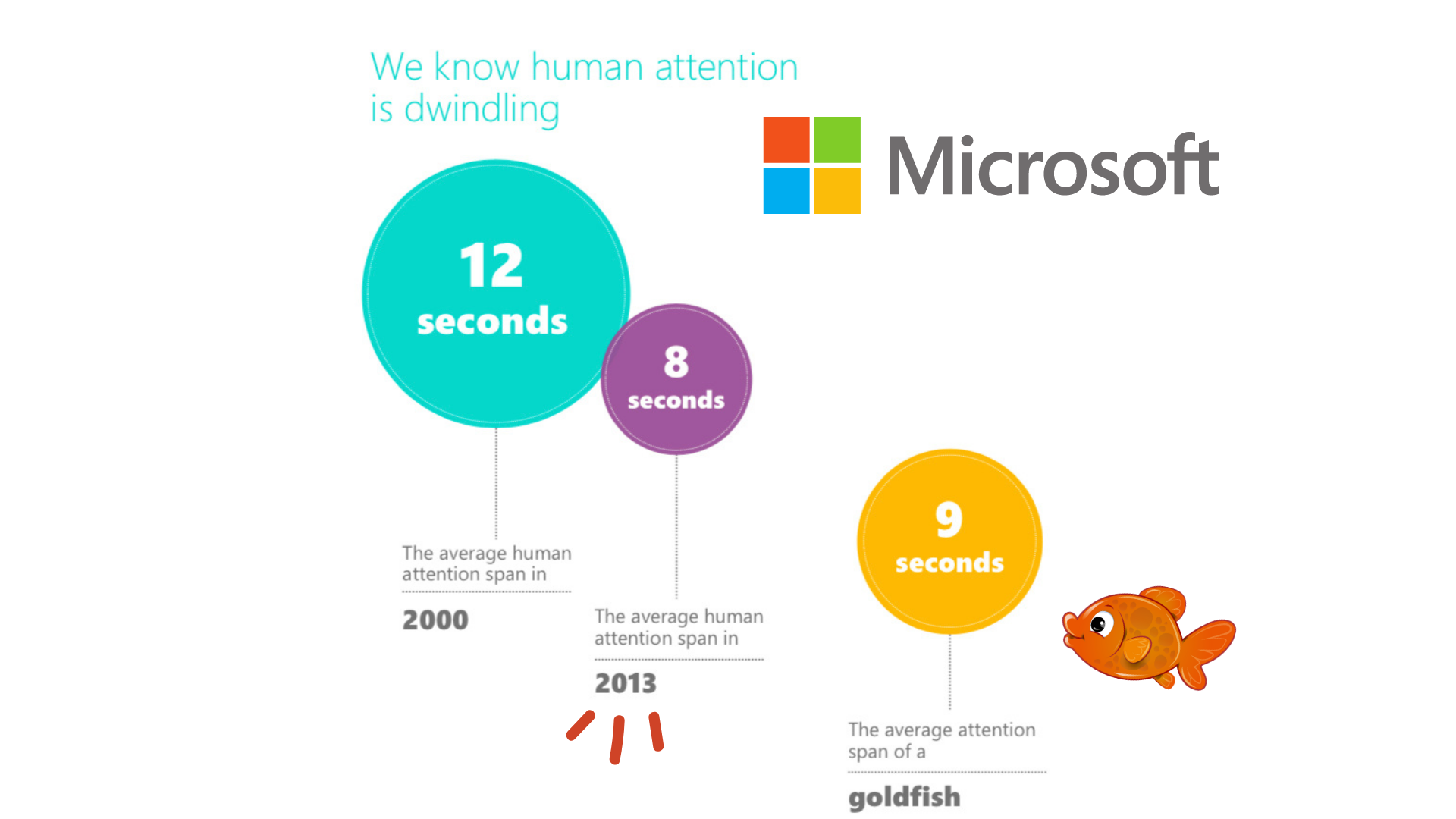
I was pretty excited to present their own research back to them, having recently come across a study from Microsoft Canada in 2015 which found that the average human attention span was shorter than that of a goldfish. It had decreased by a quarter in 13 years.
There’s a distinct lack of research on attention span since then, but Google recommends that websites should load within 1-2 seconds. When we talk about ‘attention’, it’s difficult to know what we mean - doing one task? Listening to someone when they’re speaking? Watching a tv show without looking at another screen?
How I see it, is how long we can choose to pay attention to something, to the exclusion of other thoughts. I recently tried to count to 10 and couldn’t do it without thinking of something else. I asked the audience at the presentation to do the same, who all had the same experiences. I would guess that the average attention span as of 2021 is probably 1-2 seconds (there’s been a distinct lack of research since 2015)!
So, if we all have an attention deficit, how do we classify someone as having ADHD?
As diagnosis rates of have skyrocketed over recent years, the conversation has become more confusing. Researchers have come up with a name for ADHD symptoms induced by technology - ‘Variable Attention Stimulus Trait’. When I was writing ADHD: an A to Z, I kept becoming distracted by whether I should open it up to everyone, second guessing whether ADHD was ‘real’, as the people around me constantly demonstrated signs - forever losing their keys or glasses, an inability to have a conversation without checking their phones, and double or triple-booking their free time with plans.
This continued until I read the NICE guidelines for professionals diagnosing ADHD which required the person to have '2 or more symptoms of hyperactivity/impulsivity and/or inattention which cause at least moderate psychological, social and/or educational or occupational impairment, and are pervasive, occurring in 2 or more important settings.’
In other words, to be medically diagnosed with ADHD, your life has to be pretty much falling apart in at least 2 or more areas. Given that the waiting times for assessment are up to 7 years in the UK on the NHS, and private options can cost well into the thousands, people who think they meet this criteria need some sort of support in the meantime. So the book stayed as it is, focused on ADHD rather than ‘attention’ more generally - though it could very easily be applied to many people who wouldn’t meet the diagnosis criteria.
Being diagnosed with ADHD won’t necessarily change much - learning about it will. My life became far worse for the first 6 months before I took control of my own treatment and insisted on being transferred to the NHS, but it’s a complex rollercoaster to be strapped into, especially when you throw in the opinions of others. Yes, everyone is on the attention deficit spectrum, but this doesn’t invalidate those who are diagnosed with the condition, just as much as it doesn’t invalidate those who aren’t. Ultimately, it’s just a label.

It overwhelms me to think about neurodiversity and the fact that we all have different brains in one way or another. The sheer amount of information on the internet means that it’s incredibly easy to self-diagnose and work yourself up into a place of believing you ‘have’ some kind of ‘condition’, ‘disorder’ or ‘illness’.
Typically, there’s no brain scans involved in diagnosing ADHD, as there would be if you had a tumour, for example. It is quite simply just one person’s opinion. Yes, they might be medically qualified and/or you may be paying them a lot of money. But at the end of the day, you are the person who knows you best. Having a 1-2 second attention span is probably pretty normal as of 2021, and it doesn’t mean you need to be diagnosed with ADHD.
If you find yourself unable to pay attention, start with the root of the problem. Remove the distractions (i.e technology). Sit. Breathe. Practice counting to 10. Repeat.
If you feel like you need help, get that help - and get off Google.